<?xml version="1.0" encoding="utf-8"?><feed xmlns="http://www.w3.org/2005/Atom" ><generator uri="https://jekyllrb.com/" version="3.10.0">Jekyll</generator><link href="http://sszlzzz.uk//feed.xml" rel="self" type="application/atom+xml" /><link href="http://sszlzzz.uk//" rel="alternate" type="text/html" /><updated>2026-03-31T19:48:37+00:00</updated><id>http://sszlzzz.uk//feed.xml</id><title type="html">SSZLZZZ</title><subtitle>社交媒体广泛化催生了选择焦虑症, 所以人们选择重回BLOG时代</subtitle><author><name>SSZLZZZ</name><email>ceftscp@protonmail.com</email></author><entry><title type="html">西藏纪事</title><link href="http://sszlzzz.uk//posts/2026/03/2026-03-29-blog1/" rel="alternate" type="text/html" title="西藏纪事" /><published>2026-03-29T00:00:00+00:00</published><updated>2026-03-29T00:00:00+00:00</updated><id>http://sszlzzz.uk//posts/2026/03/blog1</id><content type="html" xml:base="http://sszlzzz.uk//posts/2026/03/2026-03-29-blog1/"><![CDATA[<h1 id="自驾游">自驾游</h1>

<p>我第一次对在西藏自驾游起强烈兴趣的时候是在和家里一个做涉外工作的亲戚喝茶时，旁边的一个本地企业负责人和我说，他每年都会去318自驾半个月。我曾有两次接近自驾西藏，第一次是我前往他念他翁徒步时，我因为和两位商业向导走了一段路，便被索要路费，我在幡然醒悟他们为何在大米勇下方的营地极力告诉我通往上方湖的道路因为塌方而变得非常难走、并邀请我和他们一起走另外一条新路线后，便决定不继续向前徒步，而掉头返回拉岗村。我当时的队友继续向前了，这是我几天后她抵达原定终点发微信消息时我才知道的。我一个人返回了拉岗村，在徒步起点坐上惊险的摩托车抵达村口，路上是一群群坐在路边的毯子上准备进山挖虫草和其它东西的藏族人，司机和他们打着招呼，一边无视我希望他在悬崖旁降低车速的警告。我则努力把自己的登山包用手固定在我和司机之间。这次，我本能在盐井坐上每天两班从德钦前往昌都的班车，继续往西藏深处进发，但我此时还有工作，便只能和另外两个在拉岗村村口平房里喝茶的徒步客一起坐车返回德钦，再返回香格里拉。不过，我在香格里拉车站认识了一个很有趣的白族小伙，至今还保留着联系。</p>

<p>我第二次前往西藏的机会则是在德钦的梅里雪山观景台旁的一家餐馆里规划如何从明永冰川上方徒步进入雨崩的时候。我因为当时恶劣的雨雪天气放弃了原定的徒步计划，转而思考要不要去昌都。遗憾的是，我仍然只是坐班车返回了香格里拉，因为的假期已经所剩无几。</p>

<p>不管怎么说，在2025年夏末，因为硕士论文的主题，我终于下定决心前往西藏一趟。五星红旗张贴在经济舱的前隔板上，屏幕上放映着藏文的通告。从机场坐班车到拉萨市内不需要通过个人安检，我是在几天后重新乘坐网约车经过那个高速收费站时被要求扫脸时才知道的这件事。沿途的岔路土路上是整齐的联合拖拉机车队，电力工人穿着醒目的橙色制服站在道路右侧的半山腰上。</p>]]></content><author><name>SSZLZZZ</name><email>ceftscp@protonmail.com</email></author><category term="个人向" /><summary type="html"><![CDATA[自驾游]]></summary></entry><entry><title type="html">越王庙</title><link href="http://sszlzzz.uk//posts/2026/03/2026-03-28-blog1/" rel="alternate" type="text/html" title="越王庙" /><published>2026-03-28T00:00:00+00:00</published><updated>2026-03-28T00:00:00+00:00</updated><id>http://sszlzzz.uk//posts/2026/03/blog1</id><content type="html" xml:base="http://sszlzzz.uk//posts/2026/03/2026-03-28-blog1/"><![CDATA[<p>越王庙是我老家山上的一座寺庙，在本科时，我爸开始带我去庙里求愿。说来奇怪，我爸老家到达这座寺庙要走另外一条翻过好几个山头的山路（似乎已经被翻新成石板路），而他过去从来也没有提到过这座寺庙。在暑假的一天，他就突然决定带我去这座寺庙看看，说上面是避暑胜地。</p>

<p>随着海拔接近一千米，温度确实下降了一些。走在水泥路上，我爸告诉我，这座寺庙据称是当年越王勾践兵败时，曾在其中躲藏，而蜘蛛在门口编织了蜘蛛网，让吴兵误以为庙内无人，从而使得勾践躲过一劫。我在网上找到的由老家文旅发布的故事版本与我爸所说的大同小异，其中还提到这座庙所在的山叫越王山，这座庙被叫做越王庙。</p>

<p>上山后，首先路过的是一片破败的黄泥土房，像老家的很多古代建筑一样，这是一整栋四合院样式的、便于防御土匪的土屋，虽然新的修建在它们屋顶上方的水泥路指出它们已经不太可能发挥过去的防御作用，而显然现代的汽车路相较于古代并行的土路易辙了。可以站在水泥路上看到对面土屋因坍塌外墙而露出的内景，像木制纺织机和床头柜这样价值不高的家具显而易见地被遗弃在屋里头。由灰色瓦片覆盖的屋顶已经坍塌了三分之一，南瓜藤顺着尚未完全坍塌的土墙蔓延至了屋顶。</p>

<p>继续往前走，是到达越王庙前的最后一个村庄。村庄靠着一个水库，水库上方是唯二两栋仍然居住着活人的土屋。路边蔓延数米的蜘蛛网暗示着故事的真实性，而破碎的延申下方则用瓦片搭建起了临时的祭祀场所，瓦片覆盖着一个青花瓷碗，碗中盛有混合在红色酱汁中的玉米粒和不明肉末，不知道是祭祀什么东西，又会被什么东西吃掉。</p>

<p>继续往前走，是青葱的水稻梯田，一旁的老人正在放牛。2024年我再到这里时，老人告我们，他们今年就要搬下山了，山上的土屋也将像那栋四合院土屋那样在山区频繁的降雨和山体塌方中逐渐破败了。</p>

<p>到达越王庙前是一片废弃的实验梯田，水泥路在最后两公里处变成了土路，继续蜿蜒着向山顶行去。土路逐渐为及腰的杂草淹没，直至我们不得不在草堆在穿行。在最后几百米处，土路又变成了破碎的水泥路，不远处的凉亭暗示着我们已经到达了越王庙。</p>

<p>越王庙和凉亭在山顶的两端，中间是一个由存在多级落差的多个小石坑组成的水潭。最底下的水通过旁边的抽水机重新抽到最上面去。不过据我爸所说，在过去，这些水是自然循环的，而这口在山顶一整块岩石上形成的水潭从未干涸。</p>

<p>越王庙没有固定留守人员，门口是已经褪色的烟花残骸，门口右侧是“民间信仰场所”的标志。正门被象征性地扣上了，需要访客自己把锁解开。进入后，果真有三尊佛像在木制正厅中等着我们，中间是露天的一小片中庭。我爸煞有其事地把香火从随身的红色塑料袋里掏了出来，让我给每个佛像都拜一拜。他自己拜的时间更长，我在旁边等待了十分钟有余。结束后，我们出了院子，把门锁重新扣好，方才下山。</p>]]></content><author><name>SSZLZZZ</name><email>ceftscp@protonmail.com</email></author><category term="个人向" /><summary type="html"><![CDATA[越王庙是我老家山上的一座寺庙，在本科时，我爸开始带我去庙里求愿。说来奇怪，我爸老家到达这座寺庙要走另外一条翻过好几个山头的山路（似乎已经被翻新成石板路），而他过去从来也没有提到过这座寺庙。在暑假的一天，他就突然决定带我去这座寺庙看看，说上面是避暑胜地。]]></summary></entry><entry><title type="html">山中杂记</title><link href="http://sszlzzz.uk//posts/2026/03/2026-03-28-blog2/" rel="alternate" type="text/html" title="山中杂记" /><published>2026-03-28T00:00:00+00:00</published><updated>2026-03-28T00:00:00+00:00</updated><id>http://sszlzzz.uk//posts/2026/03/blog2</id><content type="html" xml:base="http://sszlzzz.uk//posts/2026/03/2026-03-28-blog2/"><![CDATA[<h1 id="序">序</h1>

<p>广州市周围有大量官方建设的游步道，事实上我觉得广州在这一点上做得很好。浙江省虽然有官方的步道APP，并且详细标注了大量小径，但其中很多已经事实上废弃了，我老家就有不少，可能会在未来变成户外废墟探险的好场所。不管怎么说，我还在广州市时，是实打实的徒步新手，但也在徒步沿途看到了一些很有趣的东西。</p>

<h1 id="养鸡场">养鸡场</h1>

<p>事实上，我认为在广州市周边的官方步道上徒步最危险的是遇到没有栓绳子的不明场所的看门狗。一次，我就不小心在一条支路上误入了一个养鸡场门口，三条看起来虎视眈眈的中华田园犬在土路尽头不怀好意地看着我，甚至在我返回时主动跟了上来，直到我在一公里处的分岔路随手捡了块石头吓唬他们，他们才返回去。</p>

<h1 id="宗教场所">宗教场所</h1>

<p>在一次清野过程中，我和一个中年驴友上到了一座高压吊塔旁的岩石上，看着下方的广州市，他指着一旁的经幡旗帜问我们：“知道这是什么吗？”没等我们回答，他就自答到：“这就是邪教，你们以后看到了不要理会。”这给我留下了很深的印象，因为这些经幡实际上悬挂在广州市最热门的几条热门徒步路线沿途，而绝大多数人路过时都对他们视而不见。</p>

<p>在另外一条路线上，可以看到废弃的房屋和上面褪色的广告牌，一部分路线旁边是架着铁刺网的钢丝高墙。再过去一点，一座凉亭左右被摆放着红脸关圣帝和白脸观世音菩萨，它们各自为两块条砖垫着，前面供奉着插着香火的小香炉。亭子的四个柱子上写着不同的红色字样，可惜照片上辨认不出，而我自己也忘了其内容。</p>

<h1 id="不明点码">不明点码</h1>

<p>12月的广州市仍然有鲜花盛开，虽然在阴沉的天气的衬托下显得格外凄凉。一旁的废弃白色避难所靠近窗户的白墙上被人用蓝色和红色的印章打出了七排不同排列的点状阵列，其中蓝色和红色斑点的分布都不尽相同，中间可能还有空白。我尝试使用ChatGPT分析它，却无功而返。一旁的窗户被打开，缝隙中是不明昆虫留下的泥土巢穴。</p>

<h1 id="火炉山森林公园">火炉山森林公园</h1>

<p>火炉山上到处都是小路，我最早受到沿河而下可以到达山脚的实践就是在这里完成，1中途还可能路过一片芭蕉树林和各类奇形怪状的树种。我对大自然重新产生兴趣可能就是在这里。</p>

<p>其中一条小路通往一片农家乐，最早出现的那家旁边是一个废弃的儿童游乐区，藤蔓在废弃的泳池里逐渐填补蓝色的空白，第一个可能让人想到斯普拉遁系列，第二便是激发了我对废墟探险的兴趣。可惜我对这方面的探索并未像我在徒步和户外运动上发展那么迅猛。我也不太喜欢看废墟探险相关的视频，因为我觉得他们同质性太高了。我下一次遇到正儿八经的户外废墟要等到我在浙江省开始工作的时候了。</p>

<h1 id="塔">塔</h1>

<p>当然，中国的山上和平原上到处都是塔。对我而言，印象最深刻的塔在江西的某个小县城中。我在2023年6月毕业返回浙江，期间先去衡山耍了一朝，第一次凭借网上的gpx轨迹找到一条野路的入口，当然哪路口确实好早，门口还有防火摄像头和广播提醒人们到达了正确的出发口。衡山正逢梅雨季节，云雾中的高塔仿佛没有坐落在山上，而是突兀地出现在镜头的远方。</p>

<p>不过衡山的塔不是重点。我从衡山坐绿皮火车回老家时，中途在江西的一个小县城中转。我也不知道为何这个看起来没啥特色的小城会成为一个火车中转点，但我很快意识到外面除了吃饭的地方便没有其它东西了。大众点评上切换到这里后就没啥旅游景点推荐了，我只能选了附近一座有塔的小山头，坐上公交车便赶去消磨时间。</p>

<p>这不是一座很高的山，站在山顶上正好能够眺望这座位于江西为数不多平地上的小县城的全貌。当地人似乎平日也没啥地方可逛，当天周五还是有不少人在这小山头上上下下，1下面是废弃的景区和门口几个卖当地特色食品的小推车。我很快到达了山顶，这座塔没啥突出的地方，地下室的门已经被彻底锁死了，上方的塔的墙上到处都是似乎是学生留下的“到此一游”和“XXX SB”一类的涂鸦，但侧门上的标记很不一样。</p>

<p>塔左侧的第二道门已经四道木板钉死了，木板下方是九个毛笔字：勿破门登塔 因果自负。周围似乎是该塔的具体使用历史，如“4月22号祥开上山”、“20XX年6月28号祥开早”一类的字样，有十余处。</p>]]></content><author><name>SSZLZZZ</name><email>ceftscp@protonmail.com</email></author><category term="个人向" /><summary type="html"><![CDATA[序]]></summary></entry><entry><title type="html">无编程基础文科生vibe coding自动化学术思路</title><link href="http://sszlzzz.uk//posts/2026/03/2026-03-22-blog1/" rel="alternate" type="text/html" title="无编程基础文科生vibe coding自动化学术思路" /><published>2026-03-22T00:00:00+00:00</published><updated>2026-03-22T00:00:00+00:00</updated><id>http://sszlzzz.uk//posts/2026/03/blog1</id><content type="html" xml:base="http://sszlzzz.uk//posts/2026/03/2026-03-22-blog1/"><![CDATA[<h1 id="自然语言输入">自然语言输入</h1>

<p>首先，使用自然语言告诉客户端模型（我用的是gemini3.1pro）自己的需求。</p>
<ol>
  <li>Vectorize approximately 100 existing categorized academic documents, requiring integration with a local Zotero database to read PDF files and complete information.</li>
  <li>Vectorize approximately 100MB of original field notes.</li>
  <li>It needs to be compatible with any future integration with external LLM APIs or local architectures such as llama.cpp for inference, to achieve:</li>
  <li>Using API interfaces to analyze which academic theoretical analysis frameworks the original field note vector library is suitable for. Or, using API interfaces to analyze the academic relevance between the field note vector library and existing academic document vector libraries. Both steps involve integrating web crawlers for academic resources.</li>
  <li>Iterative development of the academic document library, achieved through analyzing the original field notes and subsequent actual academic papers.</li>
  <li>Automatically compiling an image and video library primarily focused on natural landscapes. This may include future integration with ports allowing the main API or multiple APIs to call image and video analysis LLM tools.</li>
</ol>

<p>由于我使用了一个之前用中文进行的对话，所以gemini用中文回答了我，它将我的需求分为了四个板块并分别给出prompts。</p>
<blockquote>
  <ol>
    <li>Zotero 学术文献库同步与向量化引擎 (The Zotero-RAG Bridge)
      <blockquote>
        <p>使用 Python 读取本地 zotero.sqlite 提取文献元数据（作者、年份、标签），并根据相对路径找到对应 PDF。使用 LlamaParse 解析 PDF，将元数据作为 metadata 附加到生成的 Vector Chunk 上，存入 Qdrant。</p>
      </blockquote>
    </li>
    <li>田野笔记语义处理库 (The Field Note Vault)
      <blockquote>
        <p>编写一个脚本，使用 SemanticSplitterNodeParser（语义节点分割器）处理 100MB 的 Markdown/TXT 文件，识别笔记中的时间戳和地理位置作为 Metadata，存入 Qdrant 的独立 Collection 中。</p>
      </blockquote>
    </li>
    <li>学术分析与检索智能体 (The Academic Matchmaker Agent)
      <blockquote>
        <p>使用 FastAPI 和 LlamaIndex 构建一个 Router Agent。赋予 Agent 三个 Tool：1. 检索田野笔记库；2. 检索 Zotero 学术库；3. Semantic Scholar API 爬虫工具。当收到分析请求时，Agent 需自主规划步骤：先抽山田野笔记的核心现象，再去学术库检索相关理论，最后调用爬虫验证最新研究，并输出分析报告。</p>
      </blockquote>
    </li>
    <li>多模态自然景观视觉库 (The Multimodal Media Engine)
      <blockquote>
        <p>编写一个多模态管道。遍历文件夹内的图片，使用 OpenAI 的 CLIP 模型或本地多模态模型生成 Image Embeddings 存入 Qdrant。在 FastAPI 中暴露接口：允许用户上传一张照片，在库中搜索相似风景；或调用 GPT-4V/本地 LLaVA 模型对选定图片进行地理和生态描述。</p>
      </blockquote>
    </li>
  </ol>
</blockquote>

<p>在此之前，我先让它给出一个合理的本地路由方案。gemini给出的方案是混合LiteLLM本地网关。接下来，我让它使用“标准流程格式”输出这些prompts。</p>

<div class="language-plaintext highlighter-rouge"><div class="highlight"><pre class="highlight"><code>&lt;workflow_definition name="Hybrid_Routing_Strategy"&gt;
&lt;system_goal&gt;
实现一个安全的 LLM 路由网关。必须确保敏感的原始田野笔记（field_notes）绝对不暴露给外部第三方中转 API，而公开学术文献可以使用云端 API。
&lt;/system_goal&gt;

&lt;architecture_rules&gt;
1. 必须使用工厂模式（Factory Pattern）动态实例化 LLM 和 Embedding 客户端。
2. 禁止在业务逻辑中硬编码 API Base URL。
3. 每次发起 LLM 请求前，必须经过 `Security_Router` 的涉密级别检查。
&lt;/architecture_rules&gt;

&lt;core_routing_logic&gt;
```python
# 伪代码：强制路由逻辑
def get_llm_client(data_source: str, task_type: str):
    # 涉密等级 1：原始田野笔记，必须走本地
    if data_source == "field_notes":
        return initialize_client(
            base_url="[http://127.0.0.1:8080/v1](http://127.0.0.1:8080/v1)", # 本地 llama.cpp
            api_key="local_dummy_key",
            model="llama-3-8b-local"
        )
    
    # 涉密等级 2：公开学术文献，允许走第三方中转 API
    elif data_source == "zotero_academic_papers":
        return initialize_client(
            base_url=ENV["RELAY_API_BASE"], 
            api_key=ENV["RELAY_API_KEY"],
            model="gpt-4o" # 或 claude-3.5-sonnet
        )
        
    else:
        raise SecurityException("Unknown data source. Request blocked.")
```
&lt;/core_routing_logic&gt;

&lt;execution_directive&gt;
请根据 `&lt;core_routing_logic&gt;` 中的伪代码，在 FastAPI 项目中实现一个单例模式的 `RouterManager` 类，并用 LlamaIndex 的 `Settings.llm` 进行动态绑定。
&lt;/execution_directive&gt;
&lt;/workflow_definition&gt;

-----
&lt;workflow_definition name="Gateway_And_Fault_Tolerance"&gt;
&lt;system_goal&gt;
构建高并发的文档向量化（Ingestion）流水线，通过 LiteLLM 统一代理所有外部请求，并实现指数退避重试与断点续传。
&lt;/system_goal&gt;

&lt;system_architecture&gt;
```mermaid
graph TD
    A[FastAPI / LlamaIndex Ingestion Script] --&gt;|统一请求 localhost:4000| B(LiteLLM 代理网关)
    B --&gt;|Primary Route| C[廉价第三方中转 API]
    B --&gt;|Fallback on 429/500| D[官方 OpenAI/Anthropic API]
    B --&gt;|Fallback on Network Dead| E[本地 llama.cpp 备用节点]
```
&lt;/system_architecture&gt;

&lt;architecture_rules&gt;
1. 本 Python 后端代码不直接连接任何外部 LLM 厂商，只通过 `base_url="http://localhost:4000"` 与外部通信。
2. 对于 500 份 PDF 的向量化过程，必须使用 `tenacity` 库处理 HTTP 请求异常。
3. 必须使用 SQLite 记录已处理的 Chunk ID，实现断点续传。
&lt;/architecture_rules&gt;

&lt;core_retry_logic&gt;
```python
# 伪代码：强健容错与状态机管理
from tenacity import retry, stop_after_attempt, wait_exponential

@retry(stop=stop_after_attempt(5), wait=wait_exponential(multiplier=1, min=2, max=10))
def embed_and_store(chunk):
    # 1. 检查断点续传状态
    if sqlite_db.is_processed(chunk.id):
        return "SKIPPED"
        
    try:
        # 2. 统一调用 LiteLLM 网关
        vector = litellm_client.embeddings.create(input=chunk.text)
        
        # 3. 存入 Qdrant 数据库
        qdrant_db.insert(vector)
        
        # 4. 提交状态至关系型数据库
        sqlite_db.mark_as_processed(chunk.id)
        
    except RateLimitError as e:
        log.warning("Rate limit hit, triggering exponential backoff...")
        raise e # 抛出异常以触发 tenacity 重试
    except ServerError as e:
        log.error("Relay API server error, triggering fallback...")
        raise e
```
&lt;/core_retry_logic&gt;

&lt;execution_directive&gt;
请参考 `&lt;system_architecture&gt;` 的上下游关系，把 `&lt;core_retry_logic&gt;` 的伪代码转化为真实可运行的 Python 异步代码（asyncio），并提供一份基础的 `litellm_config.yaml` 配置文件，以实现主要 API 失败时自动 Fallback 的逻辑。
&lt;/execution_directive&gt;
&lt;/workflow_definition&gt;
</code></pre></div></div>

<p>之后，将这些标准格式prompts喂给VS codes中的Codex插件后，workflow正式转移到VS codes中。</p>

<h1 id="zotero-学术文献库同步与向量化引擎">Zotero 学术文献库同步与向量化引擎</h1>

<p>使用gemini转义过的prompts效率很好，condex非常准确地完成了基本架构的搭建。我按照它的指示创建了<code class="language-plaintext highlighter-rouge">.venv</code>环境运行Fastllm，把qdrant和Litellm部署在Docker中。虽然我不太喜欢docker desktop的虚拟化内存耗损率（倒不如说WSL太反人类了），但我目前手上的超轻薄本装双系统耗损显然会更大，所以我还是按照Codex指示照做了，以确保我硬编码在Litellm网关里的api不会不幸流出（我使用拼车系统）。</p>

<p>现在，第一个问题是Codex给出的本地Zotero数据库抓取架构只会抓取一级分类，而跳过了分类下方的子分类中的条目。所以我让codex增加了在抓取条目前检索<code class="language-plaintext highlighter-rouge">zotero.sqlite</code>中递归树的功能，它还主动在本地文件夹中增加了两个每次自动更新（我设置为每24小时）Zotero同步Qdrant后输出最新的递归树表格文件作为简易日志。</p>

<p>第二个问题是codex建议我增加引用<code class="language-plaintext highlighter-rouge">Zotero api</code>或是引入zotero原生的<code class="language-plaintext highlighter-rouge">key</code>标签以更准确地区分递归树，防止重名条目混淆。但我自己在zotero中从来不使用重复的分类名，所以没有增加这两个功能。</p>

<h1 id="litellm的python兼容性问题">Litellm的Python兼容性问题</h1>

<p>Litellm在Python 3.14版本上报错了，所以我按照codex建议用3.12重新创建了一个虚拟环境并重装了所有依赖。</p>

<p>与此同时，由于我不确定未来field notes和学术文件会不会是跨语言的，所以我需要频繁更改本地模型，所以我让codex增加了每次启动自动根据配置文件更新嵌入模型，我使用的都是Qdrant官方支持可直流下载的未微调模型，所以没有另外另外在docker中操作导入模型。</p>

<h1 id="田野笔记语义处理库">田野笔记语义处理库</h1>

<p>codex默认给出的方案是让我把所有田野笔记都以<code class="language-plaintext highlighter-rouge">md</code>文件格式放置在子目录<code class="language-plaintext highlighter-rouge">field_notes</code>中，让Litellm同样24小时自动更新抓取并向量化进入Qdrant。我认为markdown已经算功能简洁了（并且我的田野笔记没有什么很复杂的架构），所以没有增加一个原本我想实现的功能，即增加一个把Litellm和google docs连接在一起的接口。</p>

<p>田野笔记的向量化速度非常快，我没有使用gemini建议的语义分隔器模型，而使用了一个更主流的专门针对英文的嵌入模型，因为我改变了最早把中英文的田野笔记都输入Qdrant的想法。</p>

<h1 id="学术分析与检索智能体">学术分析与检索智能体</h1>

<p>我还没给项目增加在检索Qdrant中两个collections后线性触发的爬虫功能，因为我搭建项目到一半突然觉得自己写论文也不错。</p>

<p>作为替代方案，我用自然语言告诉codex我准备把Qdrant接入Sillytavern。我让codex帮我写了<code class="language-plaintext highlighter-rouge">retrieval-only</code>接口给Sillytavern使用，通过插件形式实现。插件的实现速度让我后悔为什么没有早点在vs codes中安装编程辅助器。不管怎么说，插件运行得很顺利，我目前还在设计专门的预设。</p>

<h1 id="多模态自然景观视觉库">多模态自然景观视觉库</h1>

<p>我也还没有开始让codex写给视觉分析模型使用的接口，因为目前我想先用文本材料来完成论文。</p>]]></content><author><name>SSZLZZZ</name><email>ceftscp@protonmail.com</email></author><category term="Sillytavern插件" /><category term="自动化" /><category term="Zotero" /><summary type="html"><![CDATA[自然语言输入]]></summary></entry><entry><title type="html">Navigating the Sacred and the Secular: The Modern Backpacking Boom on Mount Wutai</title><link href="http://sszlzzz.uk//posts/2026/03/2026-03-16-blog1/" rel="alternate" type="text/html" title="Navigating the Sacred and the Secular: The Modern Backpacking Boom on Mount Wutai" /><published>2026-03-16T00:00:00+00:00</published><updated>2026-03-16T00:00:00+00:00</updated><id>http://sszlzzz.uk//posts/2026/03/blog1</id><content type="html" xml:base="http://sszlzzz.uk//posts/2026/03/2026-03-16-blog1/"><![CDATA[<h3 id="winter-hazards-and-the-politics-of-disclaimers">Winter Hazards and the Politics of “Disclaimers”</h3>
<p>If anyone has noticed the attenuation of Buddhist elements on the Mount Wutai pilgrimage routes during the summer of 2025—as millions of sojourning and backpacking tourists, primarily young people seeking to prove themselves through bodily practices, flocked to the area—then they would undoubtedly reconfirm this phenomenon even more starkly in the winter. As in the previous year, the Mount Wutai Scenic Area and other local authorities issued an announcement announcing the official lockdown of the pilgrimage trail and other wilderness areas within the Mount Wutai Scenic Area starting from November 2025.</p>

<p>This type of announcement served to establish a clear boundary between the local management departments of Mount Wutai and the commercial organisations providing services to backpacking groups on winter pilgrimage routes regarding responsibility for trekking accidents. Every year since 2023, when I undertook my first winter backpacking route on Mount Wutai, I have heard of two or three backpackers dying on the pilgrimage trail, typically due to severe <a href="https://youtu.be/oidhlQLg9uQ">cold or extreme winter storms</a>. To address this phenomenon and avoid being implicated in such public incidents, mountainous tourism regions in China have adopted advanced “disclaimers” as a universal method.</p>
<h3 id="the-official-stance-ticket-evasion-and-conservation">The Official Stance: Ticket Evasion and Conservation</h3>
<p>For instance, Mount Wutai pilgrimage tourism is considered strictly illegal during the winter season, although no spokesperson from local authorities, such as the government of Fanshi County, has formally announced that this category of backpacking tourism is legal or formally recognised by the administration. From the perspective of the management authorities of the Mount Wutai area, this point is well-understood.</p>

<ul>
  <li>
    <p><strong>Ticket Evasion</strong>: The first justifiable reason is that most backpackers on the pilgrimage routes have never purchased a ticket from the Scenic Area; thus, they are essentially evading ticket purchase.</p>
  </li>
  <li>
    <p><strong>Safety and Maintenance</strong>: The second reason may be the prepared lockdown announcement of the Mount Wutai wilderness areas. Warnings to backpackers to avoid trekking in the mountains’ extreme winds and heavy fog in winter occupy only a small portion of this announcement, which is posted everywhere along the pilgrimage trail. Other sections point out that the dry winter climate is particularly susceptible to human-triggered forest fires, or that the temples on the peaks are undergoing maintenance.</p>
  </li>
</ul>

<div style="text-align: center;">
  <img src="https://img.sszlzzz.uk/Picgo/test%3DWS/Wallpaper/20260204_160128.jpg" alt="A1" />
</div>

<p><em>A announcement warning backpackers to do not participate in the pilgrimage trail in the winter posted on the wall of the Mongmenyan, the entrance.</em></p>

<p>These reasons are actually quite reasonable, whether viewed from the perspective of ticket-holding tourists entering the scenic area by shuttle bus or from that of the backpackers.</p>

<h3 id="an-economic-lifeline-the-transformation-of-shahe-town">An Economic Lifeline: The Transformation of Shahe Town</h3>
<p>Nevertheless, these lockdown policies have never been thoroughly implemented. Based on the standpoints of local restaurant and inn owners in Shahe Town, if backpacking and long-distance walking groups were strictly prohibited from entering this trail—one of the most popular trekking trails in China—then over half of the local tourism industry would likely lose its primary source of income.</p>

<p>When I visited Shahe Town for the first time in 2023, the street landscape here was no different from that of other towns in China’s northern provinces, due to traditional industrial decline and the resulting economic downturn. Young faces were hardly visible on the streets, and entertainment remained in forms from decades ago; one could see almost none of the milk tea shops or fast-food chains that have become widely popular in southern China. Everything changed after the craze for Mount Wutai pilgrimage routes emerged in early 2025.</p>

<p>As the town where the vast majority of backpackers depart for the trailhead, Shahe Town quickly became a favoured location for hotel chains and restaurants. When I revisited this once-obscure town (notable only for its Mount Wutai railway station) in September 2025, the commercial area had more than doubled. New hotel chains, mixed with guesthouses, spread from the old commercial district into the wastelands at the town’s edge, while chain restaurants, milk tea shops, KTVs, and other entertainment facilities filled the gaps in the business district. Now, the commercial streets of Shahe Town after 20:00 are never as desolate and silent as they were in 2023; instead, they are filled with crowds of strollers, much like China’s major cities. A driver told me that after the local coal industry declined in 2018, the locality has consistently sought to develop tourism, relying on Mount Wutai as a new pillar industry.</p>
<h3 id="a-delicate-balance-commerce-versus-tradition">A Delicate Balance: Commerce versus Tradition</h3>

<p>There has always been a concern that highly commercialised, large-scale secular backpacking and trekking might eventually interfere with, or even distort, the long-standing Chinese Mahayana Buddhist cultural practices of Mount Wutai, particularly when hundreds of non-Buddhists walk the pilgrimage trail between the five peaks every day. However, the economic benefits of such commercial practices have ultimately led local authorities to hesitate to use forceful means to completely suppress these activities.</p>

<p>A delicate balance has emerged: while local management and law enforcement departments have never recognised the legality of these pilgrimage routes, in the vast majority of cases, they tacitly allow the activity to proceed. Consequently, a massive density of videos showing backpacking groups walking on these “unofficial zone” trails circulates on Douyin and Xiaohongshu (Redbook). I have only heard of local authorities temporarily clearing backpackers from the pilgrimage trail in two circumstances: first, when backpackers unfortunately die on the path, and second, when the local management department appoints new officials.</p>

<h3 id="mixed-signals-the-reality-of-enforcement">Mixed Signals: The Reality of Enforcement</h3>
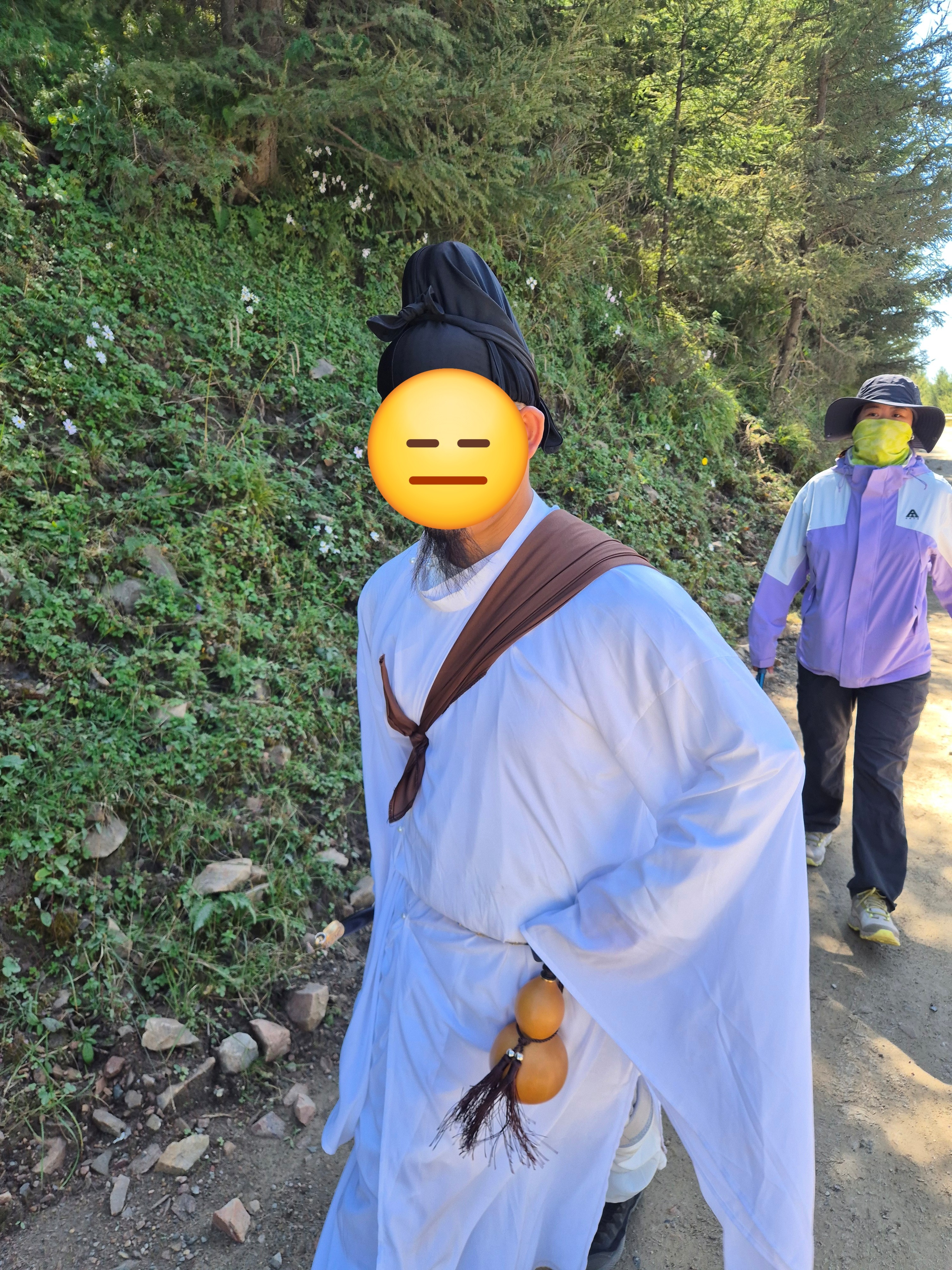
<p>Based on the current situation, the Mount Wutai pilgrimage trail remains a popular potential destination for backpackers and trekking tourists in China, and has been legalised at least partially by local authorities. Once, in September 2025, I encountered a backpacking guide dressed as Libai, a famous poet of the Chinese Tang dynasty, wearing layered traditional Chinese clothing that seemed somewhat out of place in the hot weather. He was followed by two staff members from the Shanxi Culture and Tourism Department. They told me they were recording a promotional video for the Mount Wutai trail on Douyin and WeChat.</p>

<div style="text-align: center;">
  <img src="https://img.sszlzzz.uk/Picgo/test%3DWS/Wallpaper/20250910_114509_Edited.jpg" alt="A2" />
</div>

<p><em>The ‘Libai’ who is a trekking guide as well as a blogger walked on the pilgrimage trail with official staff in September 2025</em></p>

<p>However, as winter approached, many enforcement personnel replaced these promoters and began turning back backpackers at the trail’s main halfway points. A driver described how, just days before, several backpackers had missed another popular trekking trail, the Aotai Mountain trail, in China, and how local police in Shahe town were stationed at major backpacker-favoured hotels and the Mount Wutai train station and encouraged all tourists who look like backpackers to turn back on the last day of 2025, to avoid any possibility that accidents happened on the trail. Though <a href="https://v.douyin.com/EmqWDVo82Io/">the video</a> published by backpackers on Douyin the next day showed block strategies were not as efficient as expected by local authorities.</p>]]></content><author><name>SSZLZZZ</name><email>ceftscp@protonmail.com</email></author><category term="Mount Wutai" /><category term="Pilgrimage" /><category term="Long-distance Walking" /><category term="Sojourning" /><summary type="html"><![CDATA[Winter Hazards and the Politics of “Disclaimers” If anyone has noticed the attenuation of Buddhist elements on the Mount Wutai pilgrimage routes during the summer of 2025—as millions of sojourning and backpacking tourists, primarily young people seeking to prove themselves through bodily practices, flocked to the area—then they would undoubtedly reconfirm this phenomenon even more starkly in the winter. As in the previous year, the Mount Wutai Scenic Area and other local authorities issued an announcement announcing the official lockdown of the pilgrimage trail and other wilderness areas within the Mount Wutai Scenic Area starting from November 2025.]]></summary></entry></feed>