Navigating the Sacred and the Secular: The Modern Backpacking Boom on Mount Wutai
发布时间:
Winter Hazards and the Politics of “Disclaimers”
If anyone has noticed the attenuation of Buddhist elements on the Mount Wutai pilgrimage routes during the summer of 2025—as millions of sojourning and backpacking tourists, primarily young people seeking to prove themselves through bodily practices, flocked to the area—then they would undoubtedly reconfirm this phenomenon even more starkly in the winter. As in the previous year, the Mount Wutai Scenic Area and other local authorities issued an announcement announcing the official lockdown of the pilgrimage trail and other wilderness areas within the Mount Wutai Scenic Area starting from November 2025.
This type of announcement served to establish a clear boundary between the local management departments of Mount Wutai and the commercial organisations providing services to backpacking groups on winter pilgrimage routes regarding responsibility for trekking accidents. Every year since 2023, when I undertook my first winter backpacking route on Mount Wutai, I have heard of two or three backpackers dying on the pilgrimage trail, typically due to severe cold or extreme winter storms. To address this phenomenon and avoid being implicated in such public incidents, mountainous tourism regions in China have adopted advanced “disclaimers” as a universal method.
The Official Stance: Ticket Evasion and Conservation
For instance, Mount Wutai pilgrimage tourism is considered strictly illegal during the winter season, although no spokesperson from local authorities, such as the government of Fanshi County, has formally announced that this category of backpacking tourism is legal or formally recognised by the administration. From the perspective of the management authorities of the Mount Wutai area, this point is well-understood.
Ticket Evasion: The first justifiable reason is that most backpackers on the pilgrimage routes have never purchased a ticket from the Scenic Area; thus, they are essentially evading ticket purchase.
Safety and Maintenance: The second reason may be the prepared lockdown announcement of the Mount Wutai wilderness areas. Warnings to backpackers to avoid trekking in the mountains’ extreme winds and heavy fog in winter occupy only a small portion of this announcement, which is posted everywhere along the pilgrimage trail. Other sections point out that the dry winter climate is particularly susceptible to human-triggered forest fires, or that the temples on the peaks are undergoing maintenance.
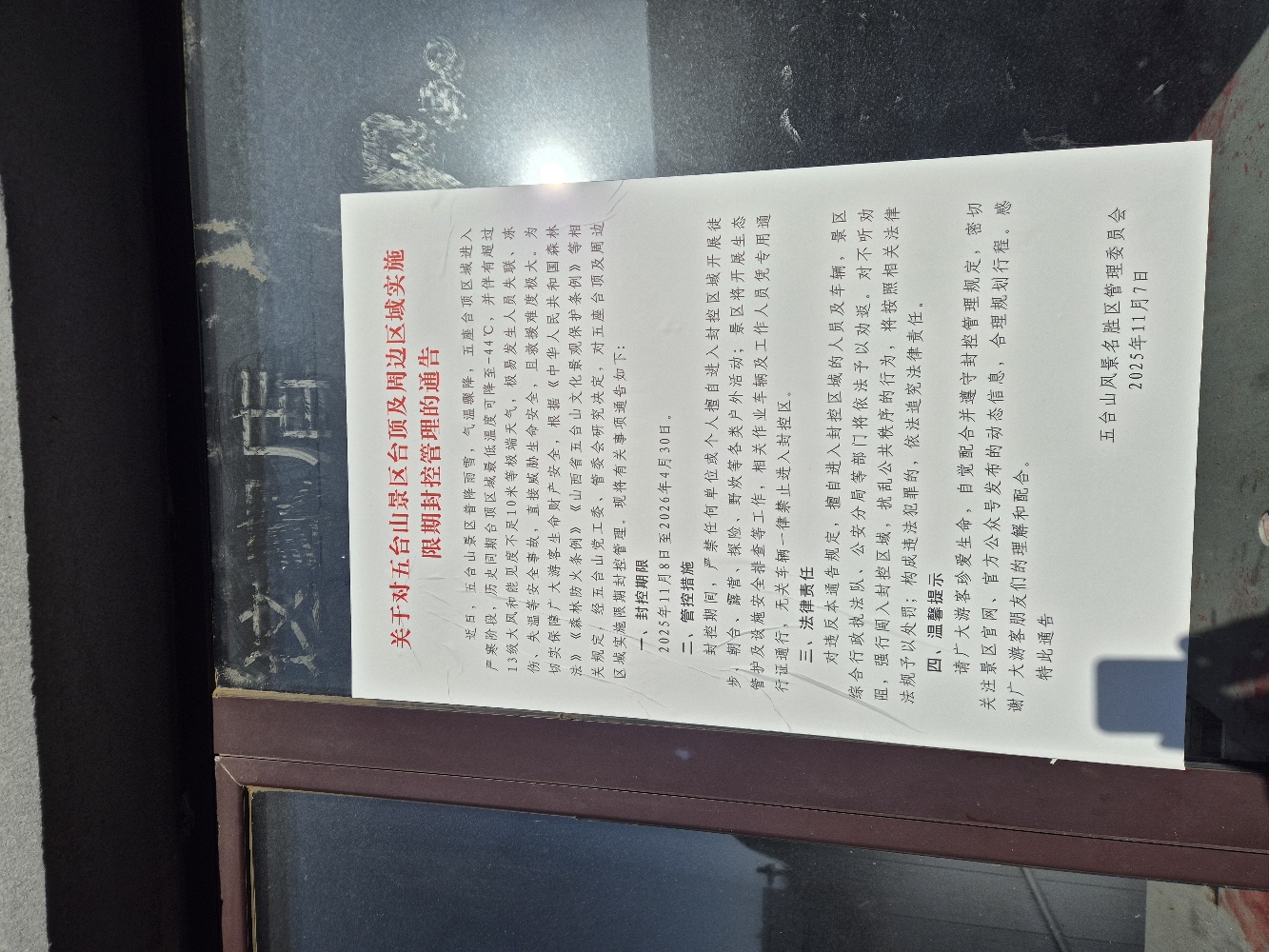
A announcement warning backpackers to do not participate in the pilgrimage trail in the winter posted on the wall of the Mongmenyan, the entrance.
These reasons are actually quite reasonable, whether viewed from the perspective of ticket-holding tourists entering the scenic area by shuttle bus or from that of the backpackers.
An Economic Lifeline: The Transformation of Shahe Town
Nevertheless, these lockdown policies have never been thoroughly implemented. Based on the standpoints of local restaurant and inn owners in Shahe Town, if backpacking and long-distance walking groups were strictly prohibited from entering this trail—one of the most popular trekking trails in China—then over half of the local tourism industry would likely lose its primary source of income.
When I visited Shahe Town for the first time in 2023, the street landscape here was no different from that of other towns in China’s northern provinces, due to traditional industrial decline and the resulting economic downturn. Young faces were hardly visible on the streets, and entertainment remained in forms from decades ago; one could see almost none of the milk tea shops or fast-food chains that have become widely popular in southern China. Everything changed after the craze for Mount Wutai pilgrimage routes emerged in early 2025.
As the town where the vast majority of backpackers depart for the trailhead, Shahe Town quickly became a favoured location for hotel chains and restaurants. When I revisited this once-obscure town (notable only for its Mount Wutai railway station) in September 2025, the commercial area had more than doubled. New hotel chains, mixed with guesthouses, spread from the old commercial district into the wastelands at the town’s edge, while chain restaurants, milk tea shops, KTVs, and other entertainment facilities filled the gaps in the business district. Now, the commercial streets of Shahe Town after 20:00 are never as desolate and silent as they were in 2023; instead, they are filled with crowds of strollers, much like China’s major cities. A driver told me that after the local coal industry declined in 2018, the locality has consistently sought to develop tourism, relying on Mount Wutai as a new pillar industry.
A Delicate Balance: Commerce versus Tradition
There has always been a concern that highly commercialised, large-scale secular backpacking and trekking might eventually interfere with, or even distort, the long-standing Chinese Mahayana Buddhist cultural practices of Mount Wutai, particularly when hundreds of non-Buddhists walk the pilgrimage trail between the five peaks every day. However, the economic benefits of such commercial practices have ultimately led local authorities to hesitate to use forceful means to completely suppress these activities.
A delicate balance has emerged: while local management and law enforcement departments have never recognised the legality of these pilgrimage routes, in the vast majority of cases, they tacitly allow the activity to proceed. Consequently, a massive density of videos showing backpacking groups walking on these “unofficial zone” trails circulates on Douyin and Xiaohongshu (Redbook). I have only heard of local authorities temporarily clearing backpackers from the pilgrimage trail in two circumstances: first, when backpackers unfortunately die on the path, and second, when the local management department appoints new officials.
Mixed Signals: The Reality of Enforcement
Based on the current situation, the Mount Wutai pilgrimage trail remains a popular potential destination for backpackers and trekking tourists in China, and has been legalised at least partially by local authorities. Once, in September 2025, I encountered a backpacking guide dressed as Libai, a famous poet of the Chinese Tang dynasty, wearing layered traditional Chinese clothing that seemed somewhat out of place in the hot weather. He was followed by two staff members from the Shanxi Culture and Tourism Department. They told me they were recording a promotional video for the Mount Wutai trail on Douyin and WeChat.
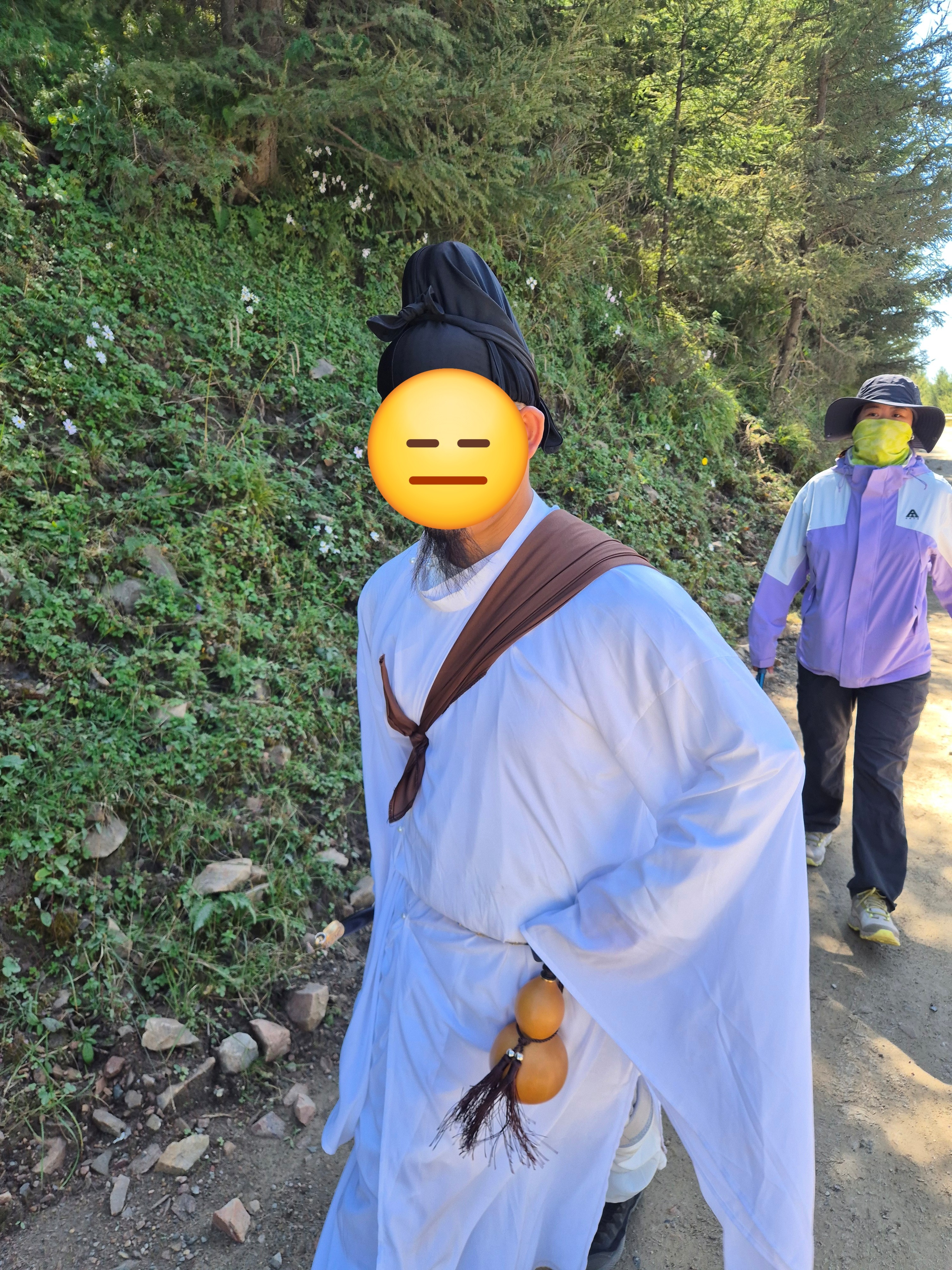
The ‘Libai’ who is a trekking guide as well as a blogger walked on the pilgrimage trail with official staff in September 2025
However, as winter approached, many enforcement personnel replaced these promoters and began turning back backpackers at the trail’s main halfway points. A driver described how, just days before, several backpackers had missed another popular trekking trail, the Aotai Mountain trail, in China, and how local police in Shahe town were stationed at major backpacker-favoured hotels and the Mount Wutai train station and encouraged all tourists who look like backpackers to turn back on the last day of 2025, to avoid any possibility that accidents happened on the trail. Though the video published by backpackers on Douyin the next day showed block strategies were not as efficient as expected by local authorities.
发表评论